

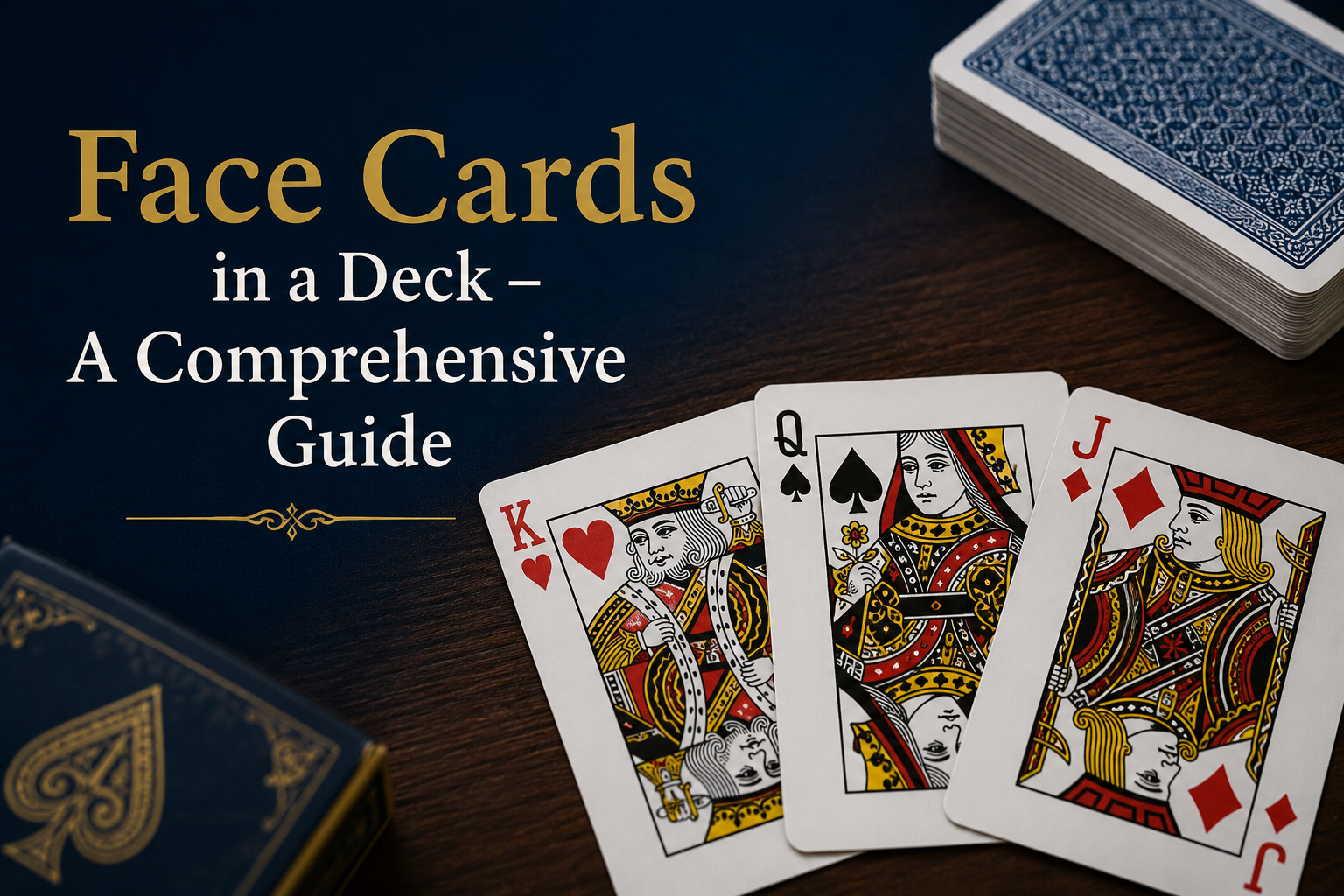
Face cards are among the most recognizable cards in a standard deck of playing cards. Unlike numbered cards, face card feature illustrated characters representing royalty, nobility, military leaders, or legendary figures. These cards have played an important role in card games, gambling, probability studies, and popular culture for centuries.
So if you’re learning card game rules, solving a probability problem, collecting playing cards, or simply curious about the artwork, understanding face card can help you appreciate the history and design behind a standard deck.
In this guide, you’ll learn how many face card are in a deck, who the face cards represent, their values in different games, their probability of being drawn, and several fascinating facts that most players never notice.
What Are Face Cards in a Deck?
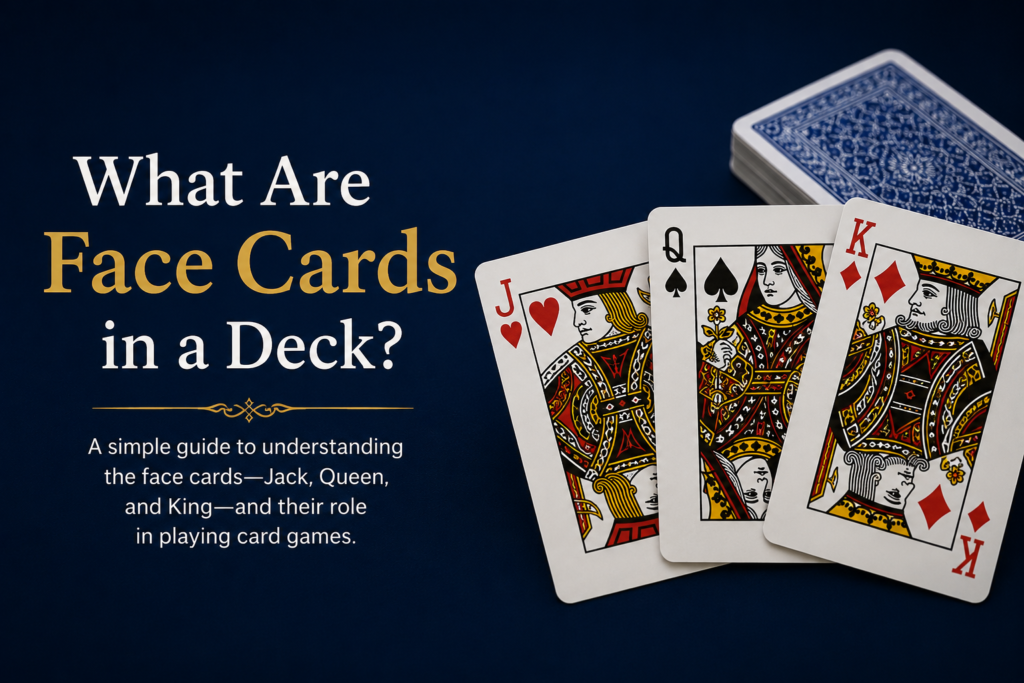
Face card are cards that display a person or character illustration instead of a number.
In a standard 52-card deck, the face cards are:
- Jack
- Queen
- King
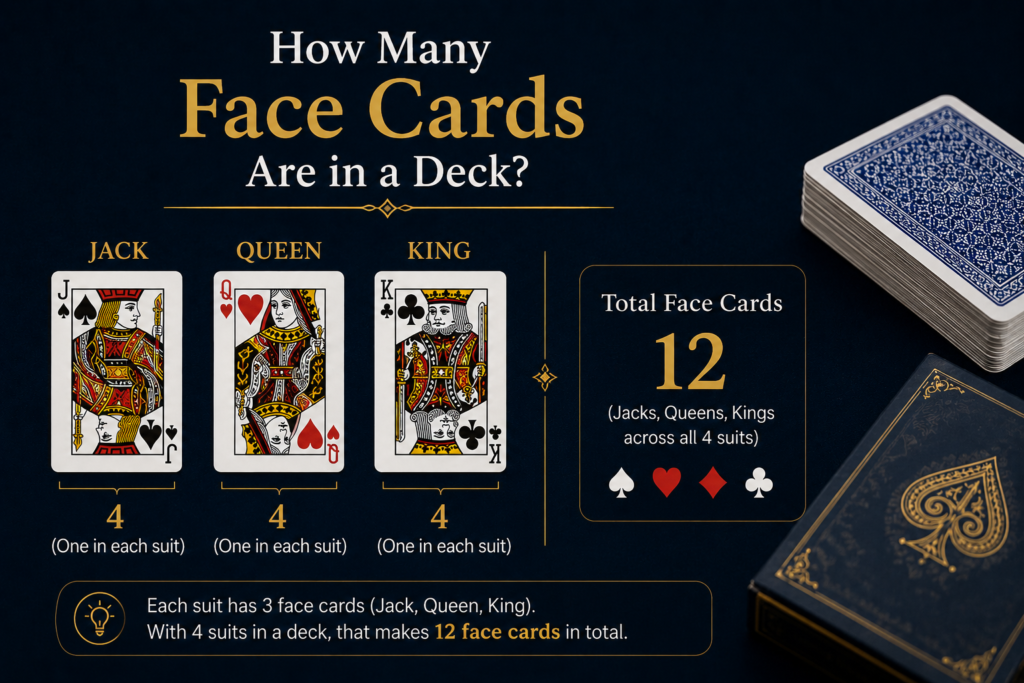
Each of the four suits contains one Jack, one Queen, and one King.
Face Cards by Suit
| Suit | Face Cards |
| Hearts | Jack, Queen, King |
| Diamonds | Jack, Queen, King |
| Clubs | Jack, Queen, King |
| Spades | Jack, Queen, King |
Since there are four suits and three face cards in each suit:
4 × 3 = 12 face cards
A standard deck contains 12 face cards.
The History of Face Cards in a Deck
Face card have a rich history that dates back hundreds of years. The earliest playing cards are believed to have originated in China during the Tang Dynasty before spreading through the Middle East and eventually reaching Europe in the 14th century.
When playing cards became popular in Europe, card makers began replacing simple court figures with kings, queens, and noblemen. French card manufacturers later standardized the suits and court cards that are still used in most modern decks today. This standardization helped make playing cards easier to recognize and reproduce across different regions.
During the 15th and 16th centuries, French card makers started associating face cards with famous historical, biblical, and legendary figures. Although these associations varied by manufacturer, they added personality and storytelling to the deck. Many of the traditional identities assigned to Kings, Queens, and Jacks are still referenced today.
Originally, face card featured full-length illustrations that appeared in only one direction. Players could sometimes identify cards based on how opponents held or rotated them. To solve this issue, manufacturers introduced the double-headed design during the 19th century. This innovation allowed face cards to look the same when turned upside down, improving gameplay and reducing opportunities for cheating.
Today, the familiar Jack, Queen, and King remain a defining feature of standard playing cards. While modern decks may use customized artwork, the concept of face cards has remained largely unchanged for centuries.
How Many Face Cards Are in a Deck?
The number of face cards depends on the deck being used.
| Deck Type | Face Cards |
| Standard 52-Card Deck | 12 |
| Deck with Jokers | 12 |
| Double Deck (104 Cards) | 24 |
| Triple Deck (156 Cards) | 36 |
Jokers are not considered face card because they do not belong to any suit and are not part of the traditional court-card structure.
Are Aces Face Cards?
One of the most common card-related questions is whether an Ace counts as a face card. The short answer is a huge No. Technically, an Ace is not a face card because it does not depict a person.
“Face cards” specifically refer to:
- Jacks
- Queens
- Kings
An Ace belongs to the category of pip cards, even though it often ranks higher than face card in many games.
Why the Confusion?
Many players associate Aces with high-value cards because they often outrank Kings.
For example:
- Poker: Ace is usually the highest card.
- War: Ace beats all face card.
- Blackjack: Ace can be worth 1 or 11.
Despite its importance, the Ace is not consider a face card.
The 12 Face Cards and Their Historical Associations
Modern playing cards originated in Europe, where card makers began associating face cards with famous rulers, warriors, and legendary figures.
Although these identities vary by region and manufacturer, the French tradition assigned specific historical characters to many court cards.
Kings
| Card | Traditional Figure |
| King of Hearts | Charlemagne |
| King of Diamonds | Julius Caesar |
| King of Clubs | Alexander the Great |
| King of Spades | King David |
Interesting Fact
The King of Hearts is often called the Suicide King because the sword appears to pass through his head.
Queens
| Card | Traditional Figure |
| Queen of Hearts | Judith or Helen of Troy |
| Queen of Diamonds | Rachel |
| Queen of Clubs | Argine |
| Queen of Spades | Pallas Athena |
The Queen of Spades is commonly associate with wisdom, strategy, and intelligence due to her connection with Athena.
Jacks
| Card | Traditional Figure |
| Jack of Hearts | La Hire |
| Jack of Diamonds | Hector of Troy |
| Jack of Clubs | Lancelot |
| Jack of Spades | Ogier the Dane |
These characters were traditionally represent as knights, warriors, or trusted military commanders.
The One-Eyed Face Cards
A fascinating detail hidden in most decks is that some face cards display only one eye. These cards are known as the One-Eyed Royals.
One-Eyed Face Cards
| Card | One-Eyed? |
| Jack of Hearts | Yes |
| Jack of Spades | Yes |
| King of Diamonds | Yes |
The profile artwork makes only one eye visible. In many home poker variations, one-eye cards are designated as wild cards.
Famous Face Card Nicknames
Several face cards have earned popular nicknames over the years.
Suicide King
The King of Hearts appears to be stabbing himself in the head with a sword.
This visual illusion earned him the nickname:
“The Suicide King.”
One-Eyed Jacks
The Jack of Hearts and Jack of Spades are called the following:
“One-Eyed Jacks.”
These cards often serve as wild cards in poker variants.
Man with the Axe
The King of Diamonds is the only king holding an axe rather than a sword. Because of this, he is sometimes called the following:
“The Man with the Axe.”
Walking King
The King of Diamonds is also known as the Walking King because he appears to be standing or moving rather than remaining stationary like the other kings.
Face Card Values in Popular Card Games
Face card values vary significantly depending on the game.
| Game | Jack | Queen | King | Ace |
| Blackjack | 10 | 10 | 10 | 1 to 11 |
| Poker | Rank 11 | Rank 12 | Rank 13 | Rank 14 |
| Rummy | 10 | 10 | 10 | 1 or 10 |
| Bridge (HCP) | 1 | 2 | 3 | 4 |
| Teen Patti | High Card | High Card | High Card | Highest |
| War | 11 | 12 | 13 | 14 |
This variation explains why face cards are valuable in some games but merely symbolic in others.
What is the Probability of Drawing a Face Card?
Face cards frequently appear in mathematics, probability, and statistics lessons. The probability of drawing any face card from a standard 52-card deck is 12/52 (3/13) because there are 12 face cards in total (4 Kings, 4 Queens, and 4 Jacks). The probability of drawing a King, Queen, or Jack individually is 4/52 (1/13) since each rank appears four times in the deck. Face card are evenly divided between red and black suits, giving a probability of 6/52 (3/26) for drawing either a red face card or a black face card. Since 40 cards in the deck are not face cards, the probability of not drawing a face card is 40/52 (10/13).
Example
If you randomly draw one card from a standard deck:
Probability of a face card = 12 ÷ 52 = 23.08%
Why Are Face Cards Double-Headed?
Have you ever noticed that face card look the same upside down? This design wasn’t always use. Early playing cards displayed full-body illustrations in only one direction. Players could accidentally reveal information by rotating cards in their hands. To solve this problem, card manufacturers introduced:
Double-Headed Designs
Benefits include:
- Easier card handling
- Faster gameplay
- Reduced card marking
- Better concealment of player actions
Today, nearly all modern face cards use reversible artwork.
Face Cards in Different Regional Decks
Not every country uses the same face-card structure.
Spanish and Italian Decks
These decks often replace the Queen with a Knight or Cavalier.
Typical court cards include the following:
- King
- Knight
- Jack
German Decks
German cards traditionally feature:
- King
- Ober
- Unter
Instead of:
- King
- Queen
- Jack
French Tarot Decks
French tarot decks contain an additional court card.
The hierarchy becomes:
- Jack
- Knight
- Queen
- King
This increases the number of face cards compared to a standard deck.
Face Cards in Custom and Themed Decks
Modern card manufacturers frequently redesign face cards.
Examples include:
- Movie-themed decks
- Sports decks
- Fantasy decks
- Historical decks
- Art decks
Even when the artwork changes, the face cards typically remain:
- Jacks
- Queens
- Kings
Players can identify them through their rank symbols rather than the illustrations alone.
Face Cards in Popular Culture
Face cards have influenced language, entertainment, and modern slang.
Examples include:
- Alice in Wonderland’s card soldiers
- Casino-themed movies
- Poker references in music
- Tarot court cards
Modern slang has even introduced the phrase:
“Face card never declines.”
The phrase humorously suggests someone is attractive enough to receive favorable treatment wherever they go.
Final Thoughts
Face cards are much more than decorative artwork in a deck of cards. They represent centuries of history, legendary rulers, military heroes, and evolving card design traditions. From the famous Suicide King and One-Eyed Jacks to probability calculations and game-specific values, face cards remain one of the most fascinating elements of playing-card culture. Understanding their history, symbolism, and role in different games provides a deeper appreciation for the standard deck that millions of people use every day.
FAQs
How many face cards are in a standard deck?
There are 12 face cards in a standard 52-card deck.
Are Jokers face cards?
No. Jokers are separate cards and are not part of the traditional face-card hierarchy.
Is an Ace a face card?
No. An Ace is a pip card, not a face card.
Which face card is called the Suicide King?
The King of Hearts.
What are One-Eyed Jacks?
The Jack of Hearts and Jack of Spades are known as One-Eye Jacks because only one eye is visible in their artwork.
What is the probability of drawing a face card?
The probability is 12/52 or approximately 23.08%.